Tuesday, September 22, 2009
squirrel
There are often many questions about caring for an orphan squirrel, which need immediate answers. Hopefully this page will answer some of those questions. All states have registered animal rehabilitators that are trained to care for orphaned and injured animals. Whenever possible you should contact your States Department of Natural Resources, Department of Fish and Game, the local chapter of the S.P.C.A. or a Veterinarian for a referral. Since this is not always practical in most emergency situations, the following should provide at least an understanding of the situation, and some care you can administer. Generally, in the spring, the female squirrel will give birth to a litter of three to four babies. They are born almost blind; one to two inches long and without fur. They would not survive long outside the nest. The mother will nurse her young approximately 75 days after birth. She will then teach them the foraging, climbing and social skills required to survive on their own. Many things can create an orphan situation. The nest could be knocked down by a storm, tree trimming or just movement by the wind. This could cause one or all of the babies to fall. A predator could take the mother and/or some of the babies. But the most common reason for a baby squirrel to fall from the nest is the lack of space. As the babies grow, more room is needed. This may cause one or more babies to be inadvertently push out of the nest. They are usually several weeks old at this stage. The mother will pick up the baby and if not injured will return it to the nest. We as humans often find this apparently helpless little creature on the ground and instinctively want to help. It is sometimes better to wait and watch up to several hours, to see if the mother returns, and let her correct this situation. If this doesn't happen, or there are other life threatening circumstances, it may be acceptable to intervene. It is very important to examine the baby for injuries, if the animal is bleeding or appears distressed in any way you should get a professional medical opinion before you proceed. As you could be doing more harm then good. The first thing is to determine if the baby is dehydrated. Check the mouth and nose for dryness. Look for dry, red, or tacky mucous membranes. Next, check for skin pliability. This can be done by gently pinching the skin on the infant's back, and raising it slightly. If the skin remains in a "tented" fashion for more that a second or two, the animal is likely dehydrated. Prior to any treatment, the baby squirrel's body must be warmed to at least 98 degrees Fahrenheit. Wrapping the baby in a warmed towel for several minutes can do this.
To reintroduce fluids, use a 1cc syringe filled with warmed "Pedialyte" this is a hydrating fluid for human babies. It should be available in any drug store. An alternative fluid would be "Gatorade". Be sure it is warmed to body temperature before you start feeding. You should allow the baby to set the pace of sucking. This takes a little practice, just remember slower is better. Follow the feeding chart below, and recheck every four hours or so, for signs of improvement. Hydrating should last no more than 24 hours. Next, what to feed your new arrival. A formula of powdered "Esbilac" mixed with water is the recommended choice. Esbilac is a milk replacement for puppies. It can be purchased at most pet supply stores; you should also pick up a 3cc syringe for a newborn or a 10cc. syringe for squirrels four weeks and older. Esbilac comes in powder form and also premixed liquid. If you are feeding one squirrel, get the smallest size can. Naturally the powder will keep longer then the liquid form. But you can prolong the life of both by pouring the mixed formula into an ice cube tray and freezing. This gives you about sixteen one-ounce doses, which you can then defrost and warm in the Microwave oven. This method is helpful if you have a lot of mouths to feed. The basic formula should consist of 1 cup of water, 1/2 cup of powder Esbilac, and 1/2 cup of whipping cream. The cream is added to fortify the formula, and add a little extra incentive to eat. An alternative small batch mixture would be 2-tsp water, 1 tsp Esbilac, and 1 tsp of whipping cream. You'll have less waste with this teaspoon method. If your squirrel has trouble with the regular Esbilac, such as diarrhea or bloating. PetAg makes an Esbilac formula with goat's milk. This can be a good alternative. Be sure the formula is warmed to 98 degrees F. but no higher then 102 degrees. Cradle the infant in the palm of one hand, then administered the formula slowly. Let the squirrel set the pace of feeding. The frequency of feeding depends on the age and weigh of the infant squirrel.The following are guidelines from which you should start, adjust these amounts as needed.Under one week of age (umbilical cord still attached), will require 9 feeding's. These should be scheduled every two hours, starting at 6 a.m. and the last one at 10 p.m. Quantity should be around 1cc. or 1/4 teaspoon. Age 2-3 weeks, feed 5 times a day, start at 1 1/2 cc of formula and increase to 3 cc Age 4-5 weeks, feed 4 times a day, start at 3 1/2 cc of formula and increase to 5 cc Age 6-7 weeks, feed 4 times a day, start at 6 cc of formula and increase to 9 cc Age 8 weeks, feed 10 to 14 cc twice a day. Begin weaning onto small pieces of solid food. After feeding, you must make sure the infant can and will relief itself. To stimulate this process use a dampened Q-tip and gentle rub it across the genitals. It is not necessary that you get results each time, but the pattern should be established early.
This is very important . . . Never feed a cold squirrel! If the squirrels body temperature is not between 98 and 102 degrees F. wrap the animal in a warmed towel and repeat this step until the body temperature is in the normal range. It is also important to keep the baby squirrel warm at all times, using a baby blanket or other suitable cloth to form a coil for the babies to sleep in. Then place it in a box. Keep this box in a warm part of your home. If the box is placed directly over the heat source, such as a heating pad, never allow it to exceed 100 degrees F. Heat only one half of the box's floor area. Also, never allow direct light to shine on the baby. As the babies eyes are very sensitive at this early stage. For the squirrel's protection, house pets should be kept away. Baby squirrels may even become accustomed to pets, which would be dangerous when released to the wild. It is much easier to care for and protect the baby squirrel if it is kept in a cage, box or other container. It should be at least two feet by two feet and at least twelve inches high to start. Putting shredded newspaper in the bottom, will help with the inevitable clean up. An old tee shirt slightly coiled makes a nice bed. Never use a material that unravels, such as a towel.As the baby squirrel grows, there will come a time when it will refuse the formula mixture. Ideally, you should wean your squirrel on a commercial dry mix. Purina makes Lab Chow, which has all the nutrients your squirrel will need. If this is unavailable, you should start with small slices of apple or pear. Seeds are also important, sunflower seeds "in the shell" should be part of the diet. A source of clean fresh water is essential for both drinking and grooming. At this stage the squirrel will be teething, you should provide a hardwood branch for it to chew on. And it would be advisable to keep it contained in a large cage or you will risk damage to your home and furnishings. You should also provide an eight by eight by twelve inch high nesting box with a three-inch entry hole, if you haven't already. It does not need to be fancy. It can even be a cardboard box, although wood is best. Give your squirrel small twigs, straw or bits of cloth so it can try to build a nest. This box is an important part of the squirrel's life. It needs to have a place where it can hide as well as sleep. Now would be the time to consider releasing your squirrel back to the wild. This will be the hardest part of its life and yours. And the usual response from children is "Why can't we keep it as a pet?" In the United States, a permit is required to keep a wild animal. While this might sound funny to some, a squirrel is a "wild" animal. And as a wild animal its behavior can be unpredictable. The only safe way to keep a squirrel in captivity is in a cage or another suitable enclosure. This will not be an easy, or pleasant task, since the squirrel cannot stand being confined. If you have raised the squirrel carefully, keeping contact to a minimum, then the transition to the wild will not be difficult. Even if human contact has been great, release is still an option, it simply requires more time and thought.
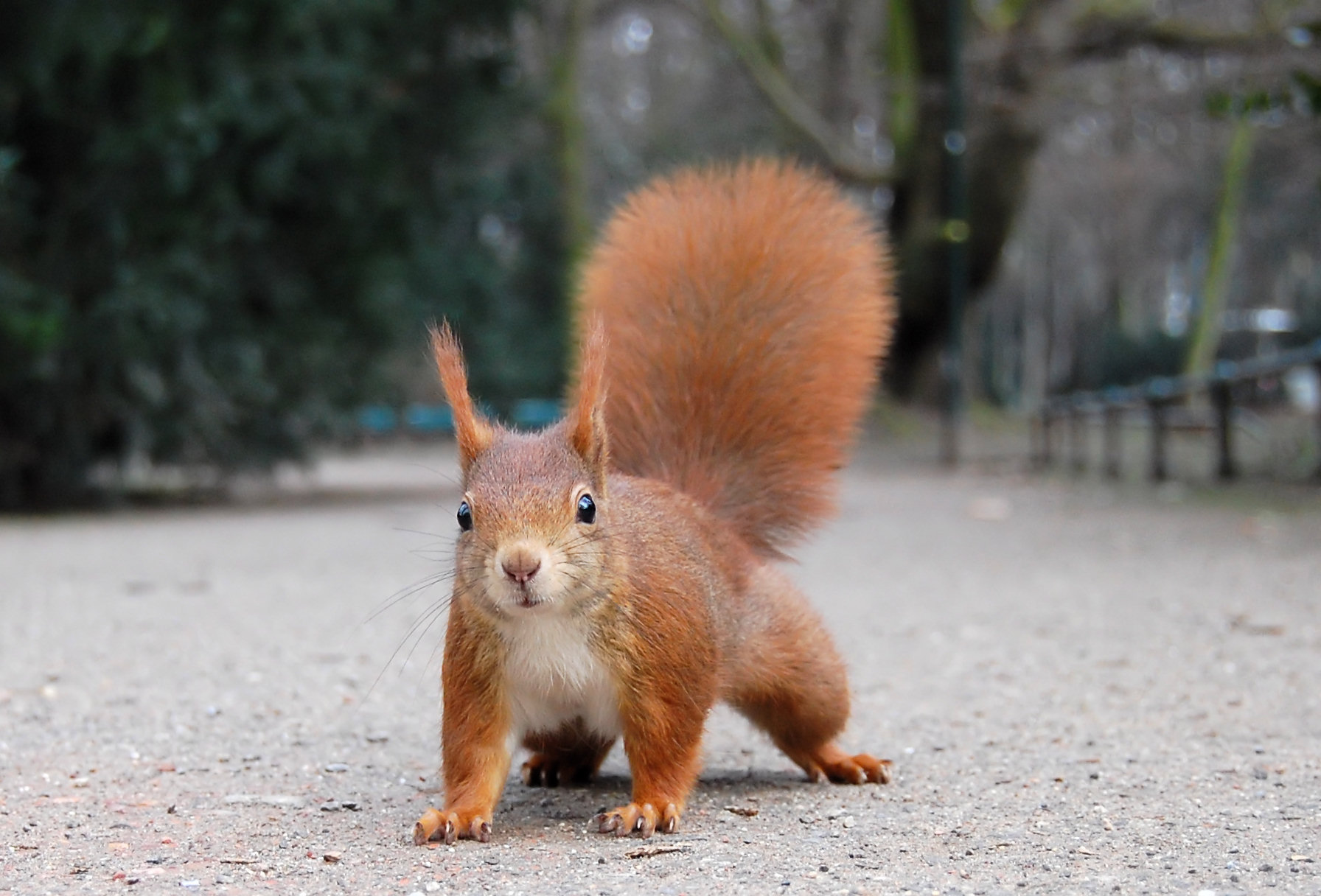
The tree squirrel is a very special animal. It is one of very few wild animals that have adapted to humans and learned to coexist with man. It can live on both natural foods and hand outs. The squirrel is an acrobatic wonder to young and old. Its large tail makes it the most recognized mammal on Earth. It amazes us with daring high wire acts, as it races through the tree branches. Its determination to find a way to get seeds from a so called "squirrel proof" bird feeder is a delight to watch. The Gray squirrel has been traced back 50 million years, from a fossil record made in North America. It is a rodent (Rodentia) in the Sciurus family. The species called Sciurus Carolinensis. The squirrel's common name can be traced back to the ancient Greeks, where Aristotle used the word "skiouros," skia meaning shade, while "oura" means tail. Thus the meaning "he who sits in the shadow of his tail" was recorded. Centuries later the French created a noun "esquirel" to describe this animal. From this the present word "squirrel" was derived. The word Gray is spelled "Grey" in the English speaking counties of Europe as well as in Canada. There are over 365 species of squirrel's or squirrel like mammals through out the world. These are divided into seven families. The three most common squirrel families are the ground squirrel, the flying squirrel and the tree squirrel. The Gray squirrel is probably the most common of the tree squirrels. They inhabit most of the northern hemisphere. The average Gray squirrel is fifteen inches long and weighs about one pound. Its diet consists of nuts, seeds and fruit. They will eat scrapes from the trash including bread, meat and even snack food. The life span of the squirrel is approximately six years. Most urban squirrels do not reach their first birthday. This is due not to predators, but rather to automobiles. Compared to its rural counterpart, which often parishes from the lack of food. There is also the Red Squirrel (Sciurus vulgaris) they are smaller then the Gray. Eight to ten inches in length, with fur that ranges from red to black. Most will have a white belly and a long fluffy red tail. Some subspecies can have red or black ear tufts. These grow more pronounced as Winter arrives. The Red squirrel is found in coniferous forests, where it feeds on the seeds and cones of the Pines, Fir's and Spruce trees.
Here are some interesting squirrel facts...Squirrel's belong to the order "Rodentia", with 1650 species, it is the largest group of living mammals. It also comprises forty percent of all present day mammal species. There are over 365 species of squirrels in seven families. They include the tree squirrel, ground squirrel, and flying squirrel. Plus many squirrel-like mammals such as the gopher, ground hog and prairie dog. Squirrels are the most active in late winter, when the mating season begins. The males will chase a females, as well as, chase off other suitors. This ritual of chasing, occurs through the trees at top speed. While they perform some of the most breathtaking acrobatics imaginable. The period of gestation varies from 33 days in the smaller species of pine squirrels, up to 60 days for the larger species such as the common gray and fox squirrels. Squirrels are usually born in the early spring. The average litter consists of four. This varies with climate and location. A second litter can occur in mid summer, if there is an adequate food supply. A female squirrel will choose the strongest male during mating season, but is unlikely to breed with that male again. This is natures way of reducing inbreeding, and to preserve the species. A baby squirrel weighs approximately one ounce at birth, and is about one inch long. They do not have hair or teeth, and are virtually blind for the first six to eight weeks. Gray squirrels come in many colors. Shades of gray are the most common followed by shades of brown. There are also pure white and pure black squirrels, but both are variations of the gray squirrel. The common Red squirrel can have an all black coat. While the Kaibab squirrel has a black body with a white tail. Both are found in coniferous forests. In the summer squirrels are most active two to three hours after sunrise, then they'll rest in the afternoon. Resuming activity again two hours before sunset. The squirrel will retire to its nest well before dark, and will rarely leave the nest in the dark. In the winter, the squirrel will complete its activities between dawn and mid- day, and will remain in or around the nest until the next day. During winter storms, or severe cold, the squirrel may not leave the nest for days. But, the tree squirrel does not hibernate! An adult squirrel normally lives alone. But will, in severe cold, share its nest with other squirrels to conserve body heat. Once the temperature rises, the guests will be on their way. Squirrels eyes are located high, and on each side of their head. This allows them a wide field of vision, without turning their head. The gray squirrels diet consists of nuts, seeds and fruit. It will eat bird eggs, bugs, and even an animal carcass if there is no other food source available. The gray squirrel requires some salt in its diet, and may find this salt in the soil along roads where snow and ice may have been. Squirrels chew on tree branches to sharpen and clean their teeth. That's why you may see many small branches on the ground around large trees. They will also chew on power lines for the same reason, this has caused many major power outages throughout the country. A squirrel's brain is about the size of a walnut. The average adult squirrel needs to eat about a pound of food a week to maintain an active life. Squirrels communicate through a series of chirps. The frequency, and the duration of the notes communicate everything from laughter to alarm. Their frequency range is normally between .01 KHz. and 10 KHz. (kilohertz). These sounds when used in conjunction with tail gestures, form the basis for squirrel communication. If a squirrel has taken up residence in your attic or crawl space, the only practical way to remove them is by trapping. A squirrel will break the shell of a nut with its teeth, then clean the nut by licking it or rubbing on its face before it is buried. This action applies a scent to the nut which helps the squirrel find it later, even under a foot of snow. The sweat glands of a tree squirrel are located on their feet, between the foot pads and on their paws between the toes. When hot or excited a squirrel will leave wet tracks on a dry surface. This scent is also used to mark the trees in their territory. If a squirrels nest becomes infested with fleas or other parasites, it will move to, or build a new nest. This is why there may be more nests then squirrels in a given area. The gray squirrel has been known to build a nest in many unusual places, in an attic or a crawl space seems to be the most common. Squirrels have also built nests in automobiles, chimney's, barbecue grills and under porches. When a squirrel senses danger, its first instinct is to stand motionless. If on the ground it will race to the closest tree, or other climbable object to escape. If it is in a tree, it will circle the trunk with its body pressed tightly to the bark. The squirrel's erratic path while crossing a street is an attempt to confuse the oncoming vehicle... thereby causing it to change direction. This is obliviously the squirrels biggest, and often last mistake. The male tree squirrel takes twice as long, as the female, to groom itself. They are the cleanest animal in the rodent family. A squirrels teeth grow continuously. Their incisor's will grow six inches per year, but stay short due to the constant wear they receive. The most common type of squirrel bite is a result of feeding a squirrel by hand. Never hold the food between your fingers, chances are very good you will be bitten. A squirrel's eyes are always looking for predators and they rarely focus on what they are eating.

Subscribe to:
Posts (Atom)